



Rates Moved Again: How to Run the Annuity Rate Reset Conversation This Quarter


By Titan Brokerage • November 12, 2026

Circular percentage icon with an upward trend line graph on a white background

If you spent the first half of this year telling clients that annuity rates were probably headed lower, you are not alone. Most of the industry expected a gradual easing. Then the Fed raised its target range in September, held it in October, and a lot of those conversations suddenly needed a rewrite.


We talk with advisors every week about renewals, replacements, and new-money cases, and the pattern right now is consistent. Clients with maturing contracts are asking whether to renew, move, or wait. Clients with new money are asking whether today’s rates are a window or a peak. Both groups want an answer, and neither answer is a guess you should be making for them.


Here is how we would structure the rate reset conversation to ensure accuracy, compliance, and utility to the client.

First, Let’s look at the Mechanics

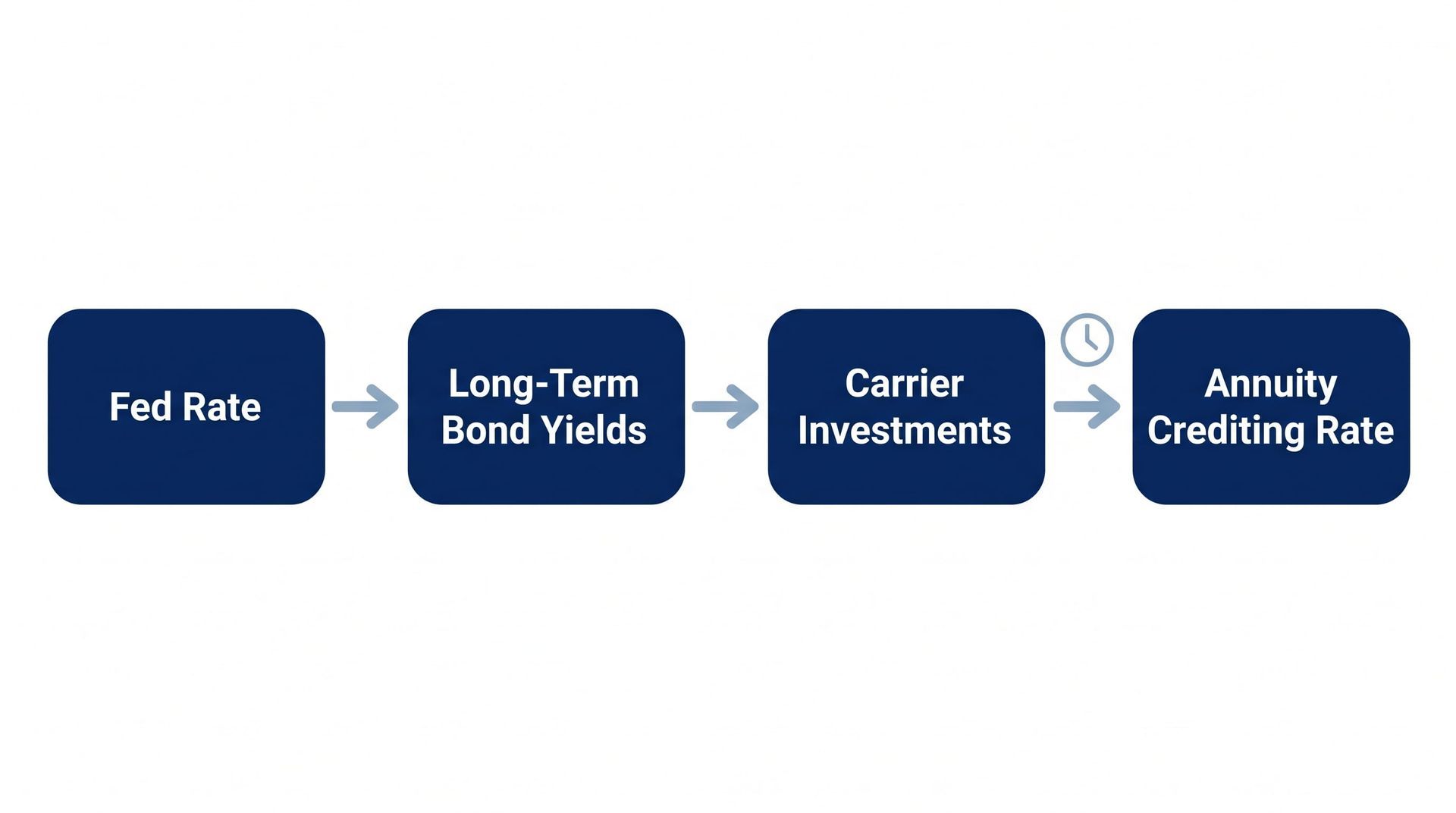
Blue flowchart: Fed rate → long-term bond yields → carrier investments → annuity crediting rate

The most common mistake we see is explaining annuity rates as if they track the Fed directly. They do not. Fixed annuity crediting rates follow longer-term bond yields, because carriers invest premiums in long-duration assets and price off what those assets can earn. Think long term treasury yields and AAA rated bonds amongst others. The Fed’s overnight rate influences that picture but does not set it.


This matters for how you position timing. In recent weeks, market commentary has described fixed annuity rates as sitting near multi-year highs, with some in the mid-six to low-seven percent range depending on the term. Those figures come from rate aggregators and marketing sources rather than regulators, and individual carrier rates change often. The point for clients is simple; carriers reprice on their own schedule, usually with a lag, and that lag is why a rate can look attractive today and different next month.


Fixed indexed annuities move more slowly still. Caps, participation rates, and spreads depend on carrier option budgets, hedging costs, and what the carrier earns on its general account. When yields rise, those parameters tend to improve gradually rather than all at once. 

Two Different Clients, Two Different Conversations

Three people chatting at a table with coffee cups in a bright office lounge

The renewal client 

is the client whose multi-year guarantee period is ending, or declared rate has just reset. Their central question is usually, “Is my current carrier’s renewal rate still competitive?” The honest answer requires you to compare three things: the renewal rate, the best available new-money rate for a comparable product, and the cost of moving. If the contract is out of its surrender period, the cost of moving may be minimal. If it is not, the math changes quickly.

The new-money client

 This client has cash from a CD, a maturing bond, a sale, or a rollover, and is deciding whether to lock in now. The temptation is to frame this as a market-timing decision. We would reframe it as a goal-matching decision; what is this money for, and when does it need to be available? A guarantee period that lines up with the client’s timeline is more valuable than a rate that looks slightly better on paper but ties up money for longer than the client wants or will only last for a period that may end prior to specific retirement deadlines, etc.

Where are the Risks

Rate-driven conversations are where mistakes tend to cluster. A few to keep in front of you.

Surrender charges and MVAs.

A higher rate elsewhere does not automatically justify leaving an in-force contract. A surrender charge and, depending on the product, a market value adjustment can erase the first year or two of any rate advantage. Run the actual numbers using the contract’s real schedule, not an estimate. If you want a refresher on explaining those features to clients, our earlier piece on surrender charges and MVAs walks through it.

Replacement and suitability.

Moving a client from one annuity to another is a replacement, and it comes with disclosure, documentation, and in many states a best-interest standard that examiners take seriously. A modest rate improvement that does not clearly outweigh costs, lost benefits, or a restarted surrender period is hard to defend in a file review. A detailed explanation of what the client gained and what they gave up will eliminate this risk.

Reinvestment risk.

A client who locks in a short guarantee at a strong rate will face another reset when it ends, possibly at a lower rate. For clients who value certainty over a longer horizon, a longer term or a laddered approach may fit better than chasing the highest short-term number.

Giving up valuable features. 

Older contracts sometimes carry benefits that newer ones do not, such as a favorable guaranteed minimum rate, an income rider with a strong roll-up, or a bonus vesting schedule. Before recommending a move as mentioned previously, confirm exactly what the client would be walking away from.

Chasing the top rate.

The highest rate on a sheet is not always the best choice. A rate well above the market deserves a question about how the carrier earns it, which ties directly to the carrier strength and ownership discussion we covered last week. Rate is one input. Financial strength, reinsurance structure, liquidity provisions, surrender schedules, MVA rules and track record are others.

Keep the Competition in View

Your clients are not only comparing one fixed annuity to another. LIMRA’s second-quarter 2026 data showed record registered index-linked annuity sales of about $23 billion, while fixed-rate deferred sales of roughly $45 billion were slightly below the prior year. Fixed indexed annuity sales of about $31 billion still outpaced RILAs, but they were down roughly 7% from a year earlier while RILA sales rose about 22%. LIMRA tied the FIA dip to average cap rates running slightly below year-ago levels. In short, plenty of pre-retirees are weighing principal-protected products against registered options that offer downside buffers with more upside potential.


The two products are not interchangeable. An FIA protects principal and limits upside through caps, participation rates, or spreads. A RILA is a registered security that offers more upside potential in exchange for a buffer or floor, which means the client can lose money beyond that protection. It also requires a securities license and prospectus delivery. That does not mean fixed products are the wrong answer. It means a client who asks about rates may also be asking, indirectly, whether they are leaving growth on the table. Be ready to explain what a fixed or fixed indexed annuity is designed to do, which is provide guarantees and predictability, and where a different tool might fit a different portion of the client’s money.

A Simple Rate Reset Checklist

When a client raises the question, we suggest working through these steps in order.


  • Pull the current contract values: account value, surrender charge schedule, free withdrawal amount, any MVA, and the exact date the guarantee period ends.


  • Identify the renewal rate in writing, including how long it is guaranteed for and what the declared rate could potentially drop to later in the life of the contract.


  • Compare two or three current alternatives with similar guarantee periods and carrier quality, not just the highest rate available.


  • Calculate the break-even point, accounting for surrender charges, MVAs, lost bonuses or riders, and any tax consequences of the transaction.


  • If a 1035 exchange is under consideration, confirm the paperwork, replacement forms, and both firm’s documentation requirements before the client signs anything. Medallion signature guarantees and wet signature requirements can slow down the process and endanger the client from obtaining the initial rate sought.


  • Document the reasoning, including the alternatives you considered and why you did or did not recommend a change.

What to Say, and What Not to Say

The best language here is plain. You can tell a client that rates are currently elevated compared with where they were a few years ago, that nobody can say how long that will last, and that your recommendation is based on their timeline and goals rather than a forecast. Stay factual and focused on the client’s goals.


What we would avoid is anything that sounds like a prediction. Phrases like “rates are about to drop, so lock in now” or “rates will keep climbing, so wait” create exactly the kind of expectation that becomes a problem later. If the Fed’s path changes, or bond yields move the other way, a client who acted on your forecast will remember who made it.


Also avoid pressure tied to the calendar. Year-end is a natural time for client reviews, and some carriers adjust rates around quarter-end, but urgency should come from the client’s situation, not from a sales deadline.

Turning a Rate Reset Into a Better Client Relationship

Rate resets are one of the few moments when clients voluntarily ask you to look at their whole picture. A client who calls about a renewal is also a client who may have an old life policy that needs a review, a spouse with no long-term care plan, or a beneficiary designation that has not been updated in a decade. Use the conversation to do the review you would otherwise struggle to schedule.


If you have a case where a renewal is coming up, or you want a side-by-side comparison of current rates, surrender schedules, and carrier strength for a specific client profile, send it over. We are glad to run the numbers with you before you meet with the client.

This article is for educational purposes for licensed professionals and is not investment, legal, or financial advice. Rates, caps, and product features change frequently and vary by carrier and state. Verify current figures and applicable replacement and suitability requirements before making recommendations.

Frequently Asked Questions

  • Do fixed annuity rates follow the Federal Reserve?

    Not directly. Fixed annuity crediting rates follow longer-term bond yields, because carriers invest premiums in long-duration assets. The Fed’s overnight rate influences that picture, and carriers usually reprice on their own schedule with a lag.

  • Should a client renew or move a MYGA when the guarantee period ends?

    It depends on three things: the renewal rate, the best available new-money rate for a comparable product, and the cost of moving. If the contract is out of its surrender period, moving may cost very little. If it isn’t, surrender charges and MVAs can quickly erase any rate advantage.

  • Is moving a client from one annuity to another considered a replacement?

    Yes. Moving from one annuity to another is a replacement and requires disclosure and documentation. Many states also apply a best-interest standard. The file should clearly show what the client gained and what they gave up.

  • What is the difference between a fixed indexed annuity and a RILA?

    An FIA protects principal and limits upside through caps, participation rates, or spreads. A RILA is a registered security that offers more upside in exchange for a buffer or floor, so the client can lose money beyond that protection. Selling a RILA also requires a securities license and prospectus delivery.

  • How should advisors talk about rates without making predictions?

    Keep it factual. Say that rates are elevated compared with a few years ago, that no one knows how long that will last, and that the recommendation is based on the client’s timeline and goals. Avoid statements like “lock in now before rates drop.”

Your Growth Starts with the Right Partner

Get the support, expertise, and carrier access to grow your business with confidence.


Insights to fuel your marketing business

Get market updates, product insights, and advisor resources delivered to your inbox.

Contact Us

SHARE THIS

Latest Posts

Two women reviewing documents in a bright office, with a printer, binders, and desk supplies nearby.
By Titan Brokerage • November 5, 2026
PE ownership, private credit, and offshore reinsurance are reshaping annuity carriers. Get a due diligence checklist and client talking points.

Two men in a meeting, one smiling and pointing at documents across a desk.
By Titan Brokerage • October 29, 2026
Discover why more pre-retirees prioritize guaranteed income over market growth and how advisors can use SPIAs and income riders to build a retirement floor.

Older man in a gray blazer reviewing documents during a meeting with two people in an office
By Titan Brokerage • October 23, 2026
Discover how life settlements provide older clients a valuable alternative to lapsing a policy, offering meaningful liquidity for long-term care and retirement.

Three people in a meeting reviewing documents at a table in a bright office
By Titan Brokerage • October 15, 2026
Learn how to guide your clients through modern long-term care options, including 7702B riders, 101(g) riders, hybrid contracts, and stand-alone policies.

September 30, 2026
Learn how to address client concerns about annuity surrender charges and market value adjustments with clear explanations and liquidity-focused conversations.

Smiling man in a suit discussing documents across a desk in a bright office
By Titan Brokerage • September 23, 2026
Learn how to secure better offers on impaired-risk life insurance cases through informal submissions, case highlighting, and carrier niche matching.

Two people in a business meeting, one speaking while seated across a table in a bright office.
By Titan Brokerage • September 16, 2026
Discover why routine life insurance policy reviews are a crucial habit for financial advisors. Learn how proactive reviews build trust and uncover new opportunities.
Two small wooden cubes on a white table, one natural with “CD” and one blue with “MYGA” in a blurred office setting
By Titan Brokerage • September 9, 2026
Compare MYGAs and Bank CDs. Learn the key differences in tax-deferred growth, early withdrawal options, and estate planning for your savings.

Snowy city skyline at dusk with illuminated highway and modern high-rise towers.
July 10, 2026
Learn how Titan Brokerage Services helps financial advisors grow with personalized support, strategic partnerships, and solutions designed for long-term success.